Risk-first learningIndependent practiceNo membership or sign-in required
Independent student audit copy. This revised Student Edition is still under instructor and learner review. The questions are formative only; formal grades and private answer keys are not available here.
FOREX VISUAL LAB · C01.4
A break needs a rule.
Closed-bar break of an earlier swing boundary
EURUSD · M15 · BID
What the candles show
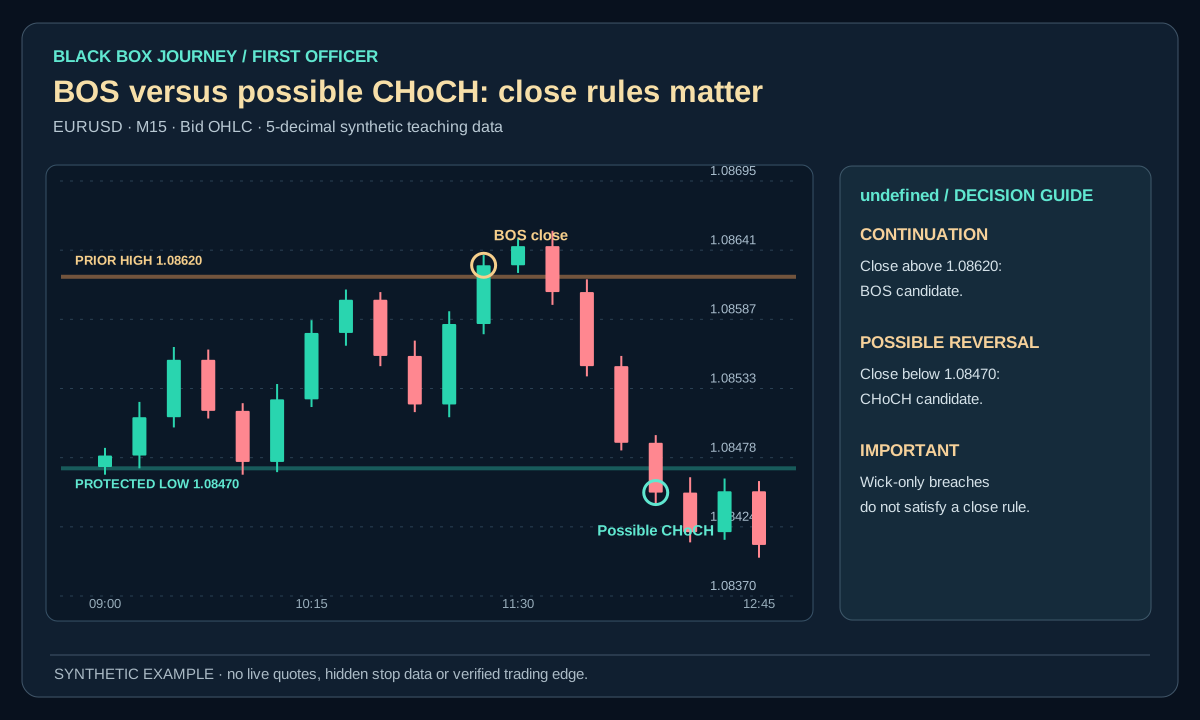
A closed EURUSD candle clears the pre-defined 1.08510 swing boundary. Here we call it a close-confirmed break candidate.
Important distinction
The close above the line is the observable event. Whether it qualifies as BOS depends on your previously frozen swing-identification and confirmation rules.
A breakout can still fail. This is not an entry recommendation. Five-decimal quotes and labels follow EURUSD conventions; broker feed conventions vary.
First Officer · C01: Market Structure · About 25–30 minutes
Safety rule: A chart label is not a forecast. Define your failure point and cash loss before considering any trade.
Your mission today
By the end you can tell a continuation break from a possible change in direction using a fixed candle-close rule.
Before you start
Complete Second Officer and have an H4, H1 or M15 demo chart with replay. Use a paper worksheet for every example. All numbers below are imaginary educational figures.
1. See the idea clearly
An established road can have a junction without immediately changing direction. On a chart, a break of structure (BOS) often refers to price breaking a relevant swing in the direction of the existing pattern. A change of character (CHoCH) describes a possible shift when the structure supporting that direction is breached. These are analytical labels, not trade guarantees.
A structure break is a description of a confirmed swing boundary being crossed; it is not automatically an invitation to enter. Traders use terms such as break of structure and change of character differently, so the academy needs operational definitions. Consistent definitions matter more than branded labels.
2. Worked example: loss before gain
An imaginary uptrend has a protected low at 102. A long at 105 with a protective level at 101.5 has 3.5 points of planned downside. At $4 per point that is −$14. A temporary wick down to 101.8 but a close at 103.4 would not breach the low under a strict close-below-102 rule. A favourable move is possible, but confirmation standards come first.
Open the diagram for full-size detail on a mobile screen. All illustrated prices are synthetic unless explicitly sourced as historical market data.
Original Black Box Journey schematic. Imaginary numbers; not a validated market strategy.
BLACK BOX JOURNEY · LESSON VISUAL WORKSHOP
See the concept, the decision and the mistake
3 original teaching figures for lesson C01.4. Read each panel in order and compare the chart, calculation or decision with the explanation above. Tap Expand for a full-size review. Diagrams and prices are classroom illustrations, not live market records or validated trading signals.
Loading 3 teaching visuals…
3. Apply a repeatable method
Declare which swing matters, whether it is fully confirmed and whether your rule needs a wick or a close beyond it. Write the boundary before the test. A wick and a closing breach produce different event counts. The same level may later act as an opposite reaction area, but that is only a hypothesis to observe.
Technical detail from the preserved source: Separate continuation breaks in the direction of an established structure from potential reversals where a protected swing is breached. State whether confirmation requires a wick penetration, candle close or multiple closes. Remember that a fast spike through a level can reverse, especially during thin liquidity.
4. Know when the explanation fails
Calling every tiny internal break a higher-timeframe reversal mixes evidence from different scales. Do not move a protected low after seeing a convenient bounce. A structure event is known only when its own confirmation condition has occurred.
Calling every micro-break a reversal produces false alarms. Drawing the swing only after its future reaction invents a signal that could not have been traded at the time.
5. Practise without the advantage of hindsight
Replay twenty structural boundaries. Mark BOS, possible CHoCH or no confirmed event using one chosen wick/close rule. Keep rejected cases and specify the first decision-time observation.
The result of a single example never proves an earnings method. Keep both rejected and eligible observations. Evaluate the decision using information available then, not later candles.
6. Distinguish a structural break from a change-of-character hypothesis
Synthetic EURUSD map: A rising sequence has a confirmed protected low at 1.08300 and a later high at 1.08700. A completed candle closing at 1.08730 can be a break-of-structure candidate if your rule requires a close beyond that high. A wick at 1.08730 with a close at 1.08670 does not meet that close-based rule. Similarly, a later close below 1.08300 may qualify as a change-of-character candidate under a specified structural definition. It does not prove a reversal.
Suppose a hypothetical long entered at Ask 1.08640 with a Bid stop at 1.08490. That is 15 pips of planned loss, or −$15 at an imaginary $1 per pip, before costs. If the protected reference fails before the entry trigger, the correct action under many plans is CANCEL, not chase.
Replay task: Capture five possible breaks before revealing the next candle. Record the level, whether a wick or a completed close crossed it, which swing was protected, and the first timestamp the event was knowable. Keep failed, ambiguous and no-trade cases in the same ledger.
Common mistake
Suppose one M15 candle dips below an internal swing while the previously defined H1 protected low remains intact. Calling that a full H1 reversal overstates the evidence. Name the smaller-scale break correctly and specify the actual H1 breach and close required by the written rule.
Plain-English glossary
BOS: A break consistent with established swing direction.
CHoCH: A possible shift through relevant prior structure.
Protected swing: A declared high or low that anchors a structural view.
Close confirmation: A rule requiring the candle to finish beyond a boundary.
Try it yourself
Replay twenty structural boundaries. Mark BOS, possible CHoCH or no confirmed event using one chosen wick/close rule. Keep rejected cases and specify the first decision-time observation. Save the initial chart, rule, decision timestamp and failure condition in your journal.
PRACTISE · TEST YOUR UNDERSTANDING
Quick check
Select an answer or type your own for each question. Press Submit practice to review the five responses. This is a formative beta exercise, not a graded assessment.
0 / 5 answered
Answer all 5 questions to submit.
What you can now do
Tell a continuation break from a possible change in direction using a fixed candle-close rule.
State what observation would make the idea invalid.
Produce an independent closed-bar decision record.
Next lesson
C01.5 · Multi-Timeframe Market Reading. Carry forward the same evidence and risk-first habits.
Student clarity check
Could you explain the idea in your own words, reproduce the calculation and complete the exercise without seeing an instructor's answer? Does the diagram actually show the concept? Please record exact lesson codes and specific points of confusion for the independent Claude audit.